
Last updated November 2, 2026
 Wrought iron
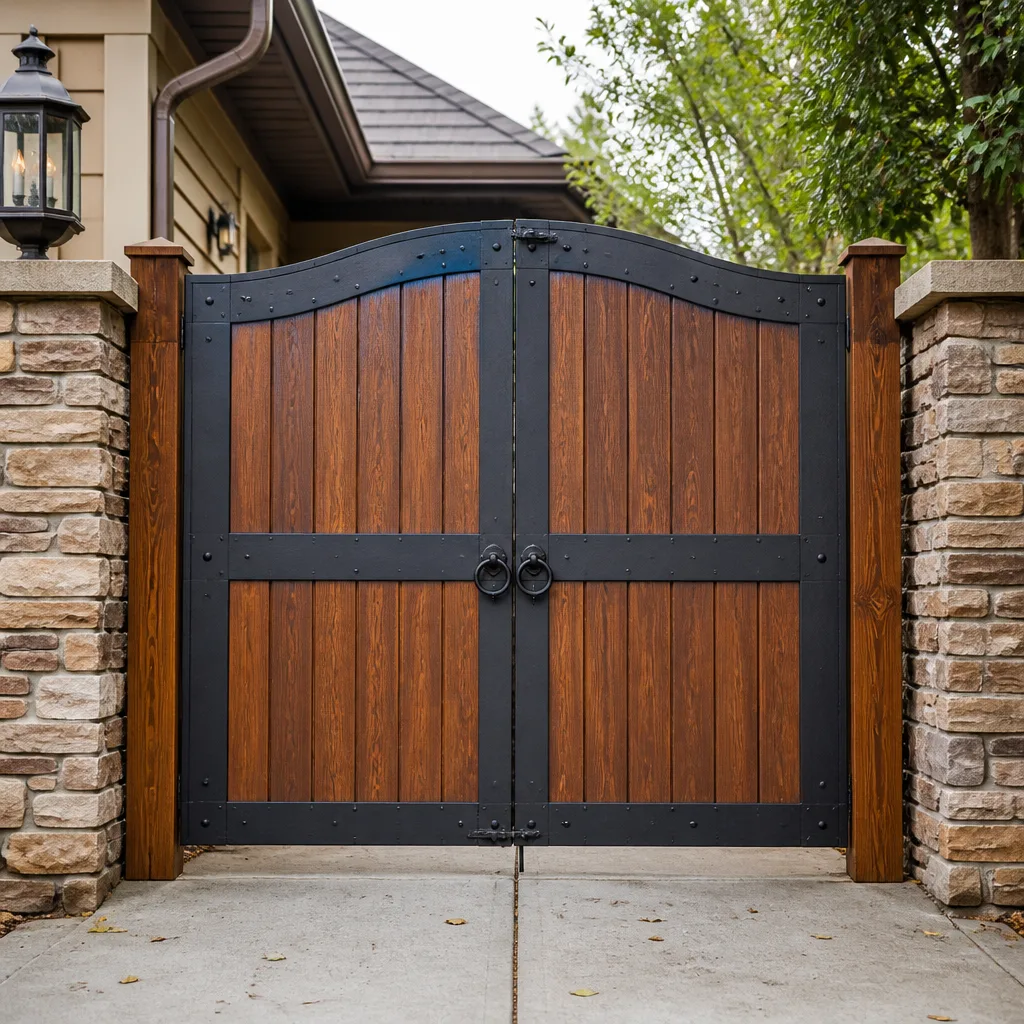 Wood & steel frame
 Farm & ranch
 Sliding driveway gates
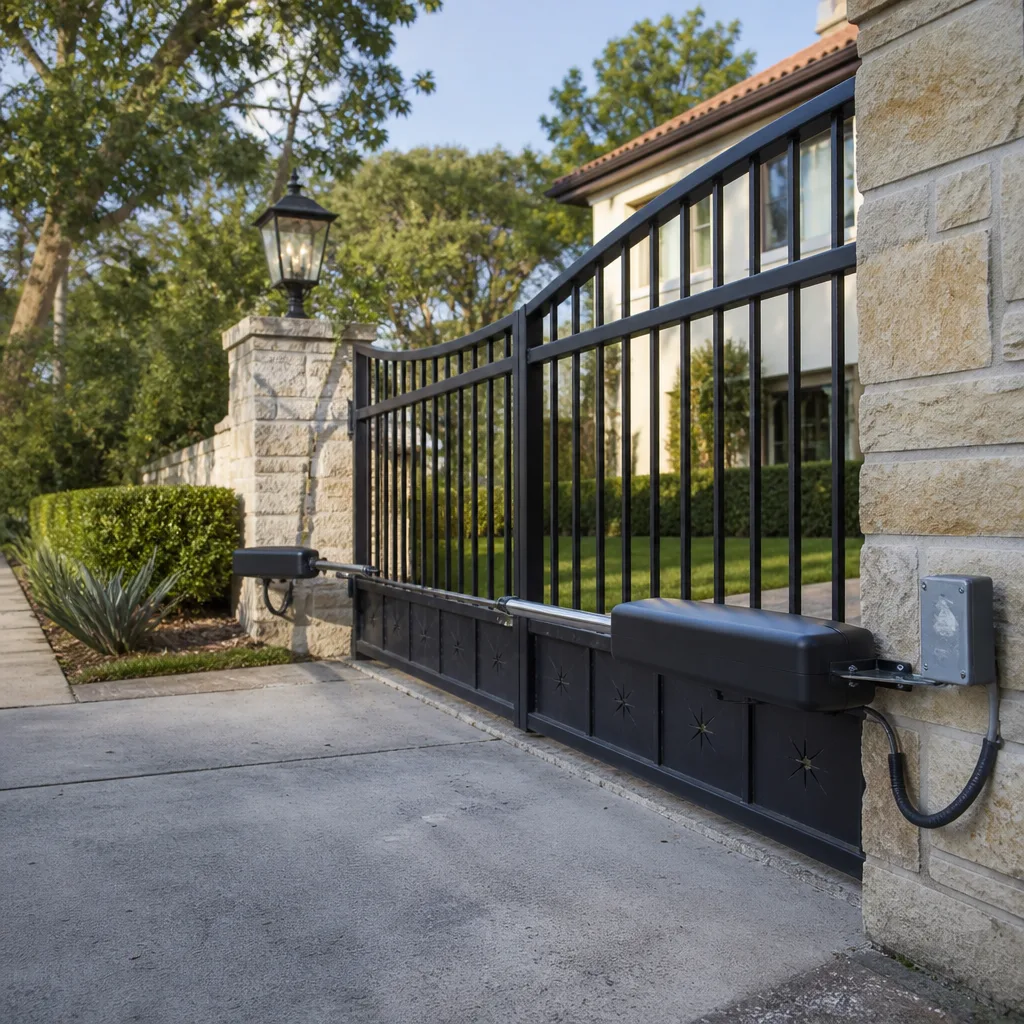 LiftMaster operators
Free on-site gate assessment - hinges, posts, and your LiftMaster or Nice gate operator checked before anything is quoted
The assessment is free and the quote is the invoice.
Get your free estimateSeasonal Gate Repair Care for Mission Viejo: Year-Round Homeowner’s Guide
Most homeowners in Mission Viejo assume gate maintenance follows a simple twice-a-year schedule. That assumption costs money. Mission Viejo’s climate looks mild on paper, but it cycles through four distinct stress patterns that attack different gate components at different times: marine layer moisture in spring, relentless UV in summer, Santa Ana wind events in fall, and overnight condensation cycles in winter. A gate that survived August can fail in November because the damage Santa Ana winds cause often takes weeks to reveal itself. This guide maps each season’s specific failure points so you can catch problems before a gate stops working entirely. For a deeper dive, see our The Complete Gate Repair Guide for Mission Viejo Homeowners.
Quick Answer
Seasonal gate care in Mission Viejo means adjusting maintenance to four local stress patterns: marine layer humidity in spring corrodes control panels, summer UV degrades rubber seals and cuts solar panel output, fall Santa Ana winds shift gate alignment and damage rollers, and winter condensation causes intermittent electrical failures inside operators. A practical schedule means checking contacts and seals in spring, cleaning and shading solar components in summer, tightening and recalibrating before Santa Ana season, and drying out operator enclosures in winter. Gate Repair Mission Viejo offers free estimates in Mission Viejo for any season-specific repair.
Styles & brands we work with
- Wrought iron
- Wood & steel frame
- Farm & ranch
- Sliding driveway gates
- LiftMaster operators
Table of Contents
- Spring: Marine Layer Moisture and Control Panel Oxidation
- Summer: UV Degradation, Rubber Seals, and Solar Panel Output
- Fall: Santa Ana Wind Season Preparation
- Winter: Condensation Cycles Inside Gate Operators
- Year-Round: A Lubrication Schedule for Mission Viejo’s Actual Temperatures
- Seasonal Maintenance Checklist: What to Do and When
- Common Mistakes to Avoid
- When to Call a Professional
Spring: Marine Layer Moisture and Control Panel Oxidation
Between March and June, Mission Viejo sits under a marine layer that rolls in most mornings and hangs around until early afternoon. The humidity level inside a gate operator enclosure can spike from 40% to 85% in under two hours as the fog moves through. That moisture is the single biggest driver of oxidation inside control panels in Mission Viejo, and it tends to concentrate on the exact places where it does the most harm: screw terminals, spade connectors, and any exposed copper on a relay.
The spring issue is not that water pours into the operator. It doesn’t, in most cases. The issue is repeated condensation cycles. The enclosure warms during the day, the fog cools it overnight, and the resulting micro-condensation layer sits on top of contact surfaces. Over six to eight weeks, a thin green film forms on brass and copper terminals. That film creates resistance. Resistance creates intermittent signals, and intermittent signals look a lot like a failing board when they’re actually a $2 cleaning job.
What we check in spring on Mission Viejo gates, in order of priority:
- Low-voltage terminal blocks: the connections between the control board and the safety loops, keypad, and photo eyes. These carry millivolt-level signals, so even slight oxidation causes dropouts.
- Battery terminals on solar operators: particularly Mighty Mule and Ghost Controls units, which use exposed spade connectors. A month of marine layer exposure is enough to cause a no-charge condition that looks like a dead panel but is actually a corroded connection.
- Limit switch contacts inside LiftMaster and FAAC operators: these are mechanical contacts, and oxidation on them changes the gate’s stop position by an inch or two. That inch becomes a problem the first time the gate fails to fully close and the safety loop won’t reset.
The fix for spring-time oxidation is not complicated, but it is specific. We clean terminal contacts with a proper electrical contact cleaner, not WD-40, and then apply dielectric grease to the contact surfaces. The grease matters more in Mission Viejo than in inland cities because the marine layer returns every year. A bare terminal cleaned in March will be re-oxidized by May. Dielectric grease creates a moisture barrier that survives the season.
For homeowners, the most useful spring check is visual: open the operator cover during daylight and look for any green or white powdery film on wire connections. If you see it, the panel needs cleaning before the gate becomes unreliable. For anyone uncomfortable opening a control panel on a powered operator, electric gate repair in Mission Viejo includes terminal cleaning as part of a standard service call.
Summer: UV Degradation, Rubber Seals, and Solar Panel Output
Mission Viejo averages over 280 sunny days a year, and from June through September the UV index sits in the high range almost daily. Two components on a gate cannot outlast that sun without intervention: rubber and photovoltaic cells. Both fail in predictable ways that are easy to spot if you know what to look for, and both are cheap to address in July and expensive to ignore until October.
Rubber gate seals, also called astragals or edge guards, take the full brunt of summer UV. The sun doesn’t just fade the material; it photo-oxidizes the outer layer, making it brittle. A seal that’s cracked across its mounting edge stops doing its job: it no longer fills the gap at the gate’s leading edge, so dust and insects get through, and it no longer cushions the closing impact, which transfers that shock into the hinge or roller assembly. In Mission Viejo, standard PVC and EPDM seals typically last four to five years before UV makes them useless. The failure is visually obvious: fine cracks that look like dry lakebed, or edges that crumble when touched.
Solar gate operators have a more insidious problem. The panels on Mighty Mule and Ghost Controls systems degrade slowly under UV, losing 0.5% to 1% of output per year. That sounds negligible until the panel is also coated with a fine layer of dust, pollen, and airborne debris. A panel producing at 85% of rating in May might be producing at 65% by August just from the coating, and the battery inside the operator is being charged less than it needs. The first sign is a gate that works fine in the morning and moves sluggishly by late afternoon. By the time the gate stops moving entirely, the battery has usually been deficit-charging for weeks and needs replacement, not just a recharge.
Summer maintenance for Mission Viejo gates should include:
- Wipe down solar panel surfaces with water and a soft cloth; no abrasive cleaner, which scratches the glass and accelerates UV damage.
- Inspect rubber seals on the gate’s leading edge and bottom for cracking; replace if they show any brittleness.
- Check the operator’s battery voltage with a simple multimeter if you have one; a 12V system sitting below 12.4V at rest is undercharged.
- Confirm that the operator enclosure is shaded wherever possible, because sustained interior heat above 120°F shortens control board life in every brand we service.
We see more failed solar operators in Mission Viejo in September than any other month, and almost all of them showed warning signs in July. A panel that’s clean and a battery that’s holding charge will carry a gate through the hottest stretch without issue.
Fall: Santa Ana Wind Season Preparation
Santa Ana wind events are the single biggest cause of gate misalignment in Mission Viejo. A 60 mph gust puts lateral stress on a slide gate track that a standard installation wasn’t engineered to absorb, and the damage shows up weeks later as grinding noise, a gate that shudders on its track, or a limit switch that no longer stops the gate in the right position. The wind itself rarely destroys a gate outright. What it does is loosen hardware and shift tolerances a few millimeters at a time, and those millimeters turn into mechanical wear that compounds for months afterward.
Santa Ana season in Mission Viejo runs from September through November, with occasional events as late as January. The right time to prepare is the second half of September, before the first major wind event arrives. The preparation list is short and mechanical.
Roller guides and track alignment: On a slide gate, check the roller guides for side play. Grab the gate mid-track and push laterally. If it moves more than a quarter inch, the guides need adjustment before a 50 mph gust uses that play as a lever. A gate that bangs against its track during a wind event will oval-out the roller holes and eventually require replacement of the rollers, the brackets, and in bad cases the track itself.
Gate stops: Every slide gate has end stops that catch the gate at full open and full close. If those stops are loose, the wind slams the gate into them repeatedly, and the shock transmits directly into the operator’s gearbox. We service gate repair in Mission Viejo calls every November where the original problem was a wind event three weeks earlier and a gate stop with a half-inch of play.
Limit switch calibration: On a LiftMaster or FAAC slide operator, the limit switch tells the motor where to stop. If the gate shifted a quarter inch during a wind event and the limit switch wasn’t recalibrated, the motor keeps driving for a fraction of a second after the gate hits the stop. That fraction of a second is torque on the gearbox, and repeated over days it’s what turns a working operator into a rebuild job.
Fall prep in Mission Viejo, step by step:
- Tighten the mounting bolts on roller brackets, gate stops, and the operator’s drive mechanism.
- Test the gate manually by disconnecting the operator and sliding it full travel; listen for grinding or binding.
- Reconnect and run a full open-close cycle; watch for shuddering or hesitation anywhere in the travel.
- Recalibrate limit switches if the gate doesn’t stop cleanly at both ends.
- Inspect the track for debris. Santa Ana winds fill tracks with eucalyptus leaves and grit faster than any other season.
If a gate already shows symptoms of wind damage, grinding noise, a gate that stops mid-travel, or visible track wear, address it before the next wind event rather than after. Wind damage compounds exponentially when the gate continues to run out of alignment.
Winter: Condensation Cycles Inside Gate Operators
Mission Viejo winters are mild by any national standard, but the overnight temperature swing from low 40s to high 60s creates a condensation cycle that matters more than the cold itself. The problem is thermal cycling: the operator enclosure cools overnight, water vapor from the daytime air condenses on the metal enclosure interior, and then the operator heats up when the gate runs, evaporating the moisture into micro-droplets that settle on the circuit board and terminals.
LiftMaster and FAAC operators are particularly susceptible to a specific winter failure in Mission Viejo: intermittent connectivity at the master/slave terminal block and at the safety loop input. The terminals are close together, the condensation film bridges them, and the control board starts reading phantom signals. The gate opens fine one day, refuses to close the next, then works again on the third day. Homeowners call this a “flaky gate.” It’s actually a moisture bridge, and it’s most common between December and February when the daily temperature swing is widest.
Winter maintenance in Mission Viejo focuses on keeping the inside of the operator dry and preventing condensation from becoming a standing water problem:
- Check the operator’s drain holes. Many enclosures have weep holes at the bottom that clog with dust and insect debris over the summer. If the holes are plugged, winter condensation pools instead of draining.
- Verify the rubber gasket on the enclosure door. A gasket that hardened during summer UV loses its seal, and winter moisture works its way in through the gap.
- Look for white residue on the board. That residue is mineral left behind after condensation evaporated. It’s a signal that the board has been getting wet and should be inspected for early corrosion.
- Consider desiccant packs inside the enclosure during the wettest months. They’re a five-dollar preventive that keeps the interior humidity below the condensation threshold.
The other winter-specific check is on gate hinges, regardless of operator brand. Cold air doesn’t cause hinge failure, but the winter temperature swings in Mission Viejo accelerate the breakdown of grease in hinge pins. A hinge that was fine in October can start squeaking by January, and a squeaking hinge is a hinge that’s wearing metal-on-metal.
Year-Round: A Lubrication Schedule for Mission Viejo’s Actual Temperatures
Manufacturer maintenance sheets say to lubricate gate hardware every six months. That’s a national-average answer that ignores local climate. In Mission Viejo, the temperature range and the marine layer combine to break down lubricants more aggressively in some seasons than others, and the schedule that actually works splits the year into three lubrication passes rather than two.
The reason is simple: Mission Viejo’s overnight lows in winter dip far enough to thicken standard grease, and summer highs soften it to the point that it runs out of pivot joints. The right schedule accounts for both extremes.
Early spring (March): Apply white lithium grease to hinge pins, pivot points, and the slide gate’s roller bearings. The marine layer of late spring will sit on these surfaces for months; the grease creates a moisture barrier. Skip this pass and the moisture works into the pivot clearances.
Mid-fall (October): This is the critical pass for Santa Ana season. Clean the slide gate track and roller guides, remove any accumulated grit, and apply a silicone-based lubricant to the track and rollers. Silicone handles the dry, dusty conditions of fall better than grease, which attracts dust that turns into abrasive paste inside roller bearings. On swing gates, re-lubricate hinge pins after the summer heat has thinned the existing grease.
Winter (January, condition-dependent): Not a full pass. In Mission Viejo, only re-lubricate in winter if you hear squeaking or feel resistance. The cold weather thickens grease and makes it harder to work into tight pivots. A symptom-driven winter lube beats a scheduled one.
What to lubricate, specifically:
- Slide gate: roller bearings, track surface, chain or belt drive components
- Swing gate: hinge pins, opener arm pivots, lock mechanism
- All gates: latch and handle components if exposed
What not to lubricate: the control board, the limit switches, the safety loops, or any electrical component. Grease on a limit switch is a service call waiting to happen.
Seasonal Maintenance Checklist: What to Do and When
Here’s the full year in Mission Viejo, consolidated into a reference list. For more guides & resources, visit our blog. Print it or save it. Each season answers one core question: what is the climate going to attack in the next 90 days, and what’s the cheapest way to get ahead of it?
Spring (March – May): Moisture Defense
- Open the operator enclosure and check for oxidation on terminals and connectors
- Clean any corrosion with electrical contact cleaner
- Apply dielectric grease to low-voltage signal terminals
- Check battery terminal spade connectors on solar operators
- Test safety loops and photo eyes for signal dropouts
- Lubricate hinge pins and pivot points before the marine layer settles in
Summer (June – August): UV and Heat Management
- Clean solar panels with water and a soft cloth
- Inspect rubber gate seals for cracking; replace if brittle
- Check battery resting voltage on solar systems
- Shade the operator enclosure where possible
- Listen for grinding or squeaking at the hottest part of the day
Fall (September – November): Santa Ana Preparation
- Tighten roller bracket and gate stop mounting bolts
- Test gate for lateral play; adjust roller guides if movement exceeds a quarter inch
- Run full open-close cycle and recalibrate limit switches
- Clean track of debris before wind events load it further
- Lubricate track and rollers with silicone-based lubricant
Winter (December – February): Condensation Control
- Check operator drain holes; clear clogs
- Verify enclosure gasket seal; replace if hardened
- Look for white mineral residue on control boards
- Add desiccant packs inside the enclosure
- Re-lubricate only if squeaking or resistance is present
For anyone who wants a professional set of eyes on the gate before each season’s stress pattern hits, Gate Repair Mission Viejo home provides service details, and gate installation in Mission Viejo covers replacement when a gate has reached the end of its serviceable life.
Common Mistakes to Avoid
- Lubricating the track on a slide gate with heavy grease. Mission Viejo’s fall dust load turns grease into an abrasive compound that eats roller bearings. Use silicone spray on tracks, grease only on sealed bearing surfaces.
- Ignoring a grinding noise because the gate still opens. Grinding is metal-on-metal contact. By the time the gate stops moving, the repair has gone from a roller swap to a track replacement, and the price difference is significant.
- Opening a control panel to “take a look” without disconnecting power. Gate operators carry 120V even when the gate isn’t moving. A casual inspection turns into a serious shock hazard. This is one of those situations where a trained professional is the right call.
- Spraying WD-40 into the operator to stop a squeak. WD-40 is a solvent, not a lubricant. It strips existing lubrication and leaves a residue that attracts dust. The squeak comes back worse within a week.
- Waiting until a Santa Ana warning to check gate alignment. By the time the wind is forecast, the hardware that needed tightening has already been vibrating loose for weeks. Prepare in September, not the day before a wind event.
- Assuming a solar gate that’s slow in the afternoon is a bad motor. In Mission Viejo summer, nine times out of ten it’s a dirty panel or a tired battery. Both are cheap fixes compared to motor replacement.
When to Call a Professional
Some seasonal maintenance is safe for any homeowner: cleaning solar panels, checking seals, clearing track debris. Other work is not. If a gate is popping a breaker, if the operator hums but the gate doesn’t move, if the gate reverses direction on its own, or if you see burn marks, melted wire insulation, or smoke from the operator, stop troubleshooting and call someone who works on gates every day. These are symptoms of motor failure, board failure, or a serious electrical short, and they won’t resolve with cleaning or lubrication. Gate Repair Mission Viejo offers free estimates in Mission Viejo. Call (866) 562-1205 and we’ll diagnose the issue and quote the repair before any work starts.
See the difference
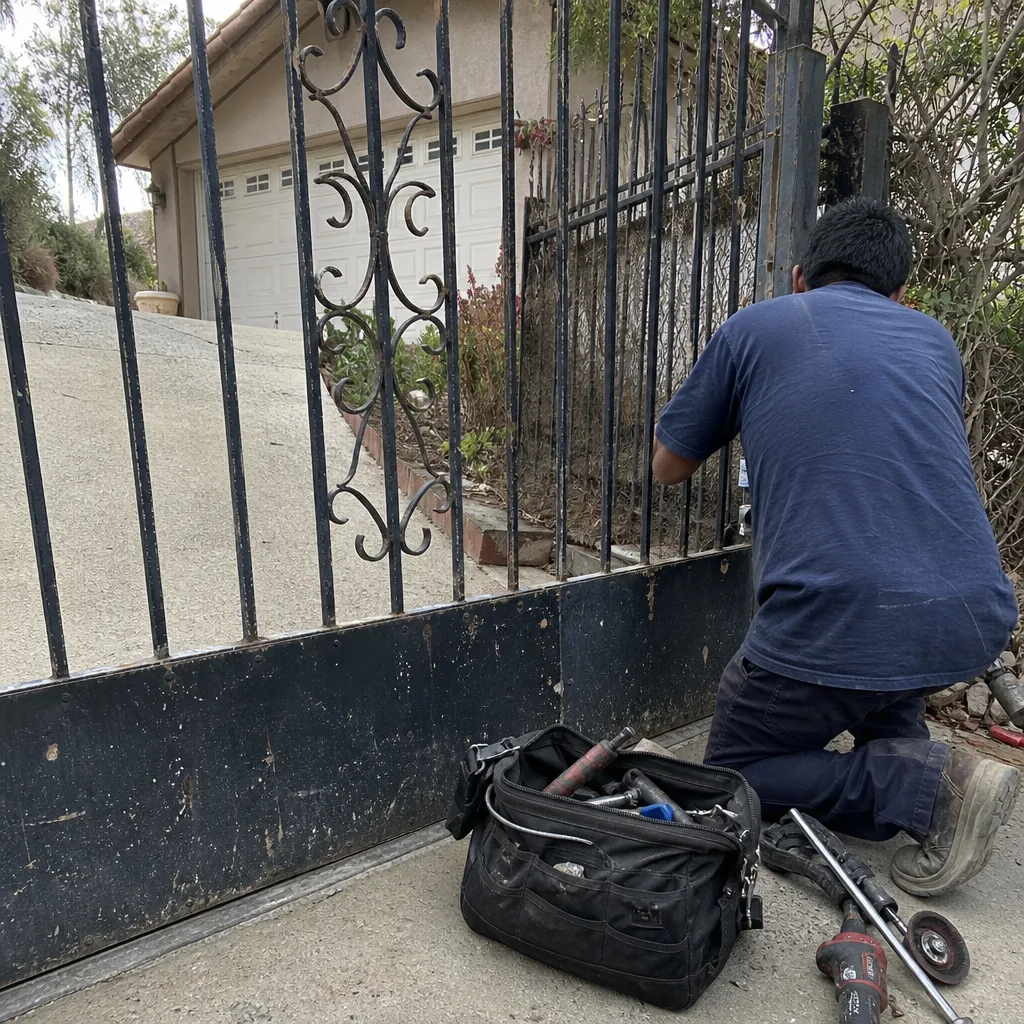 Before
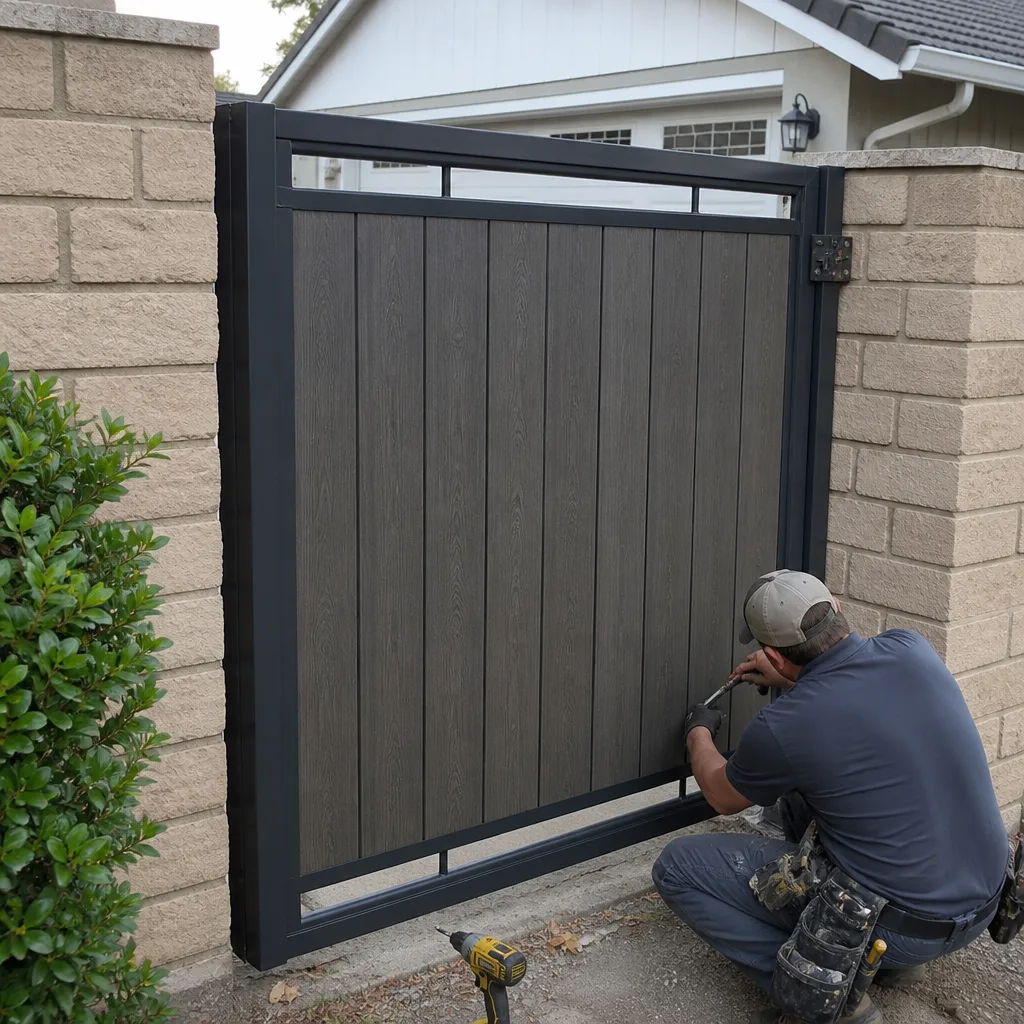 After
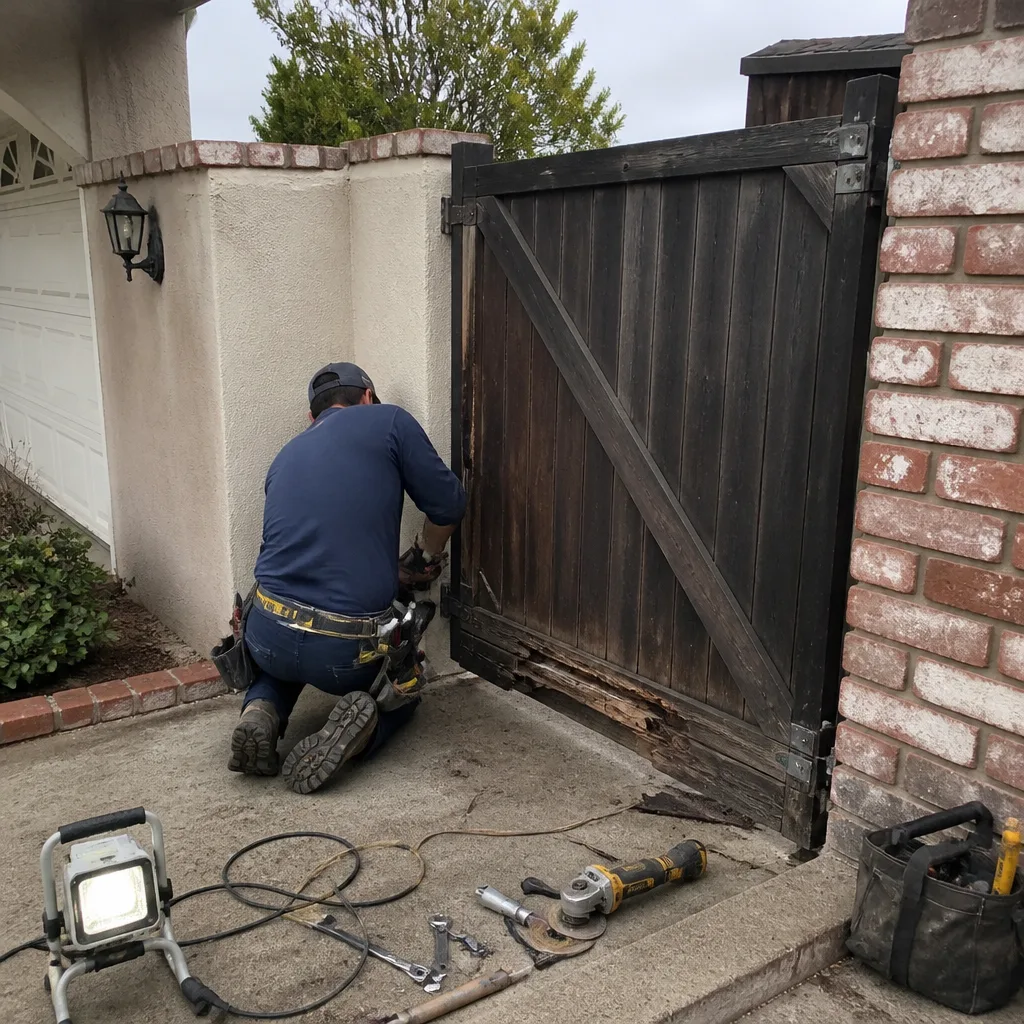 Before
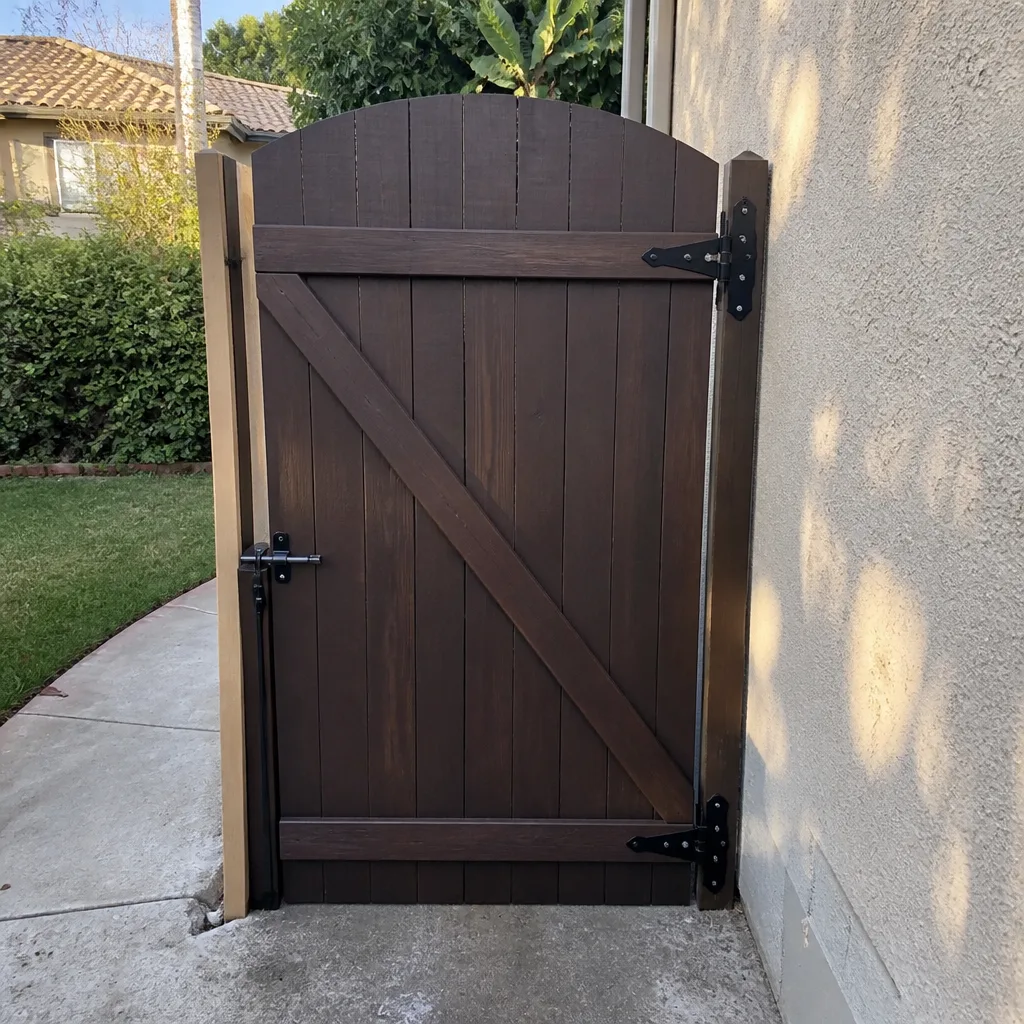 After
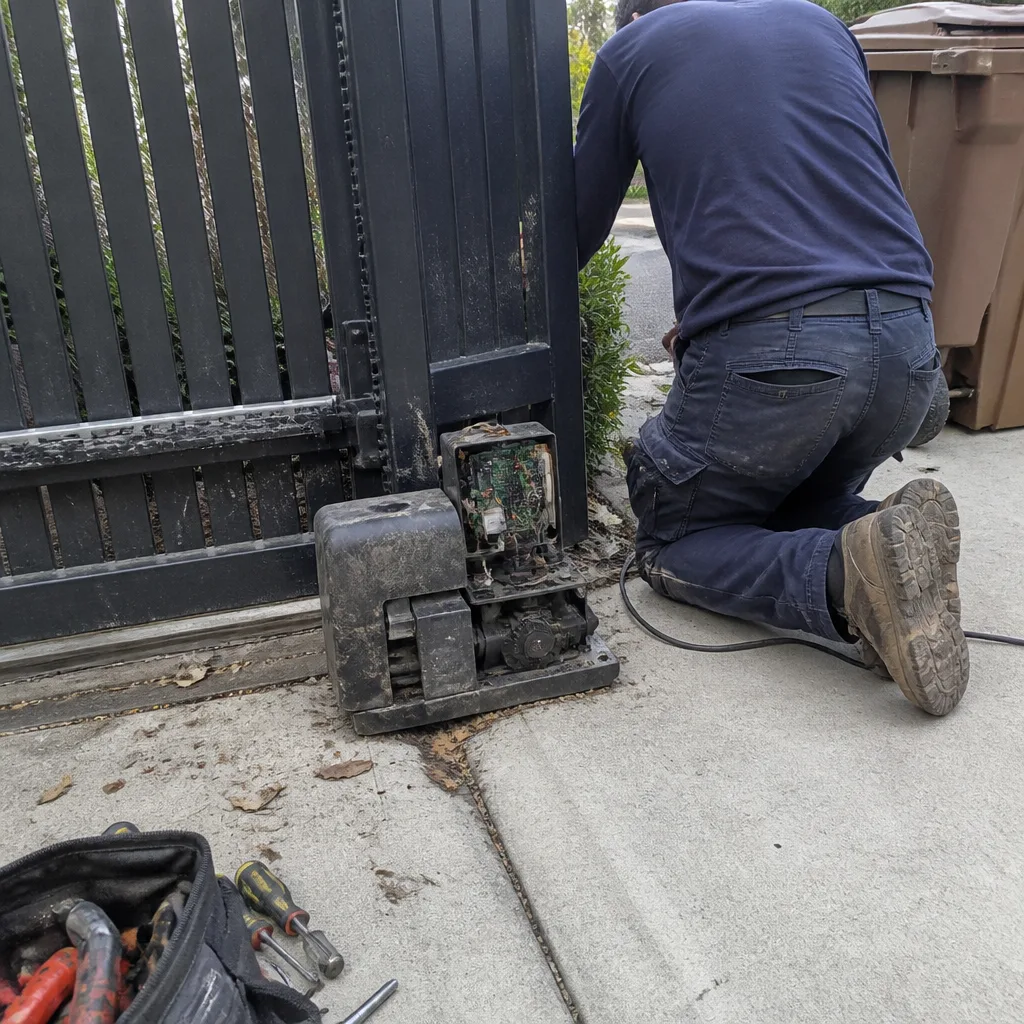 Before
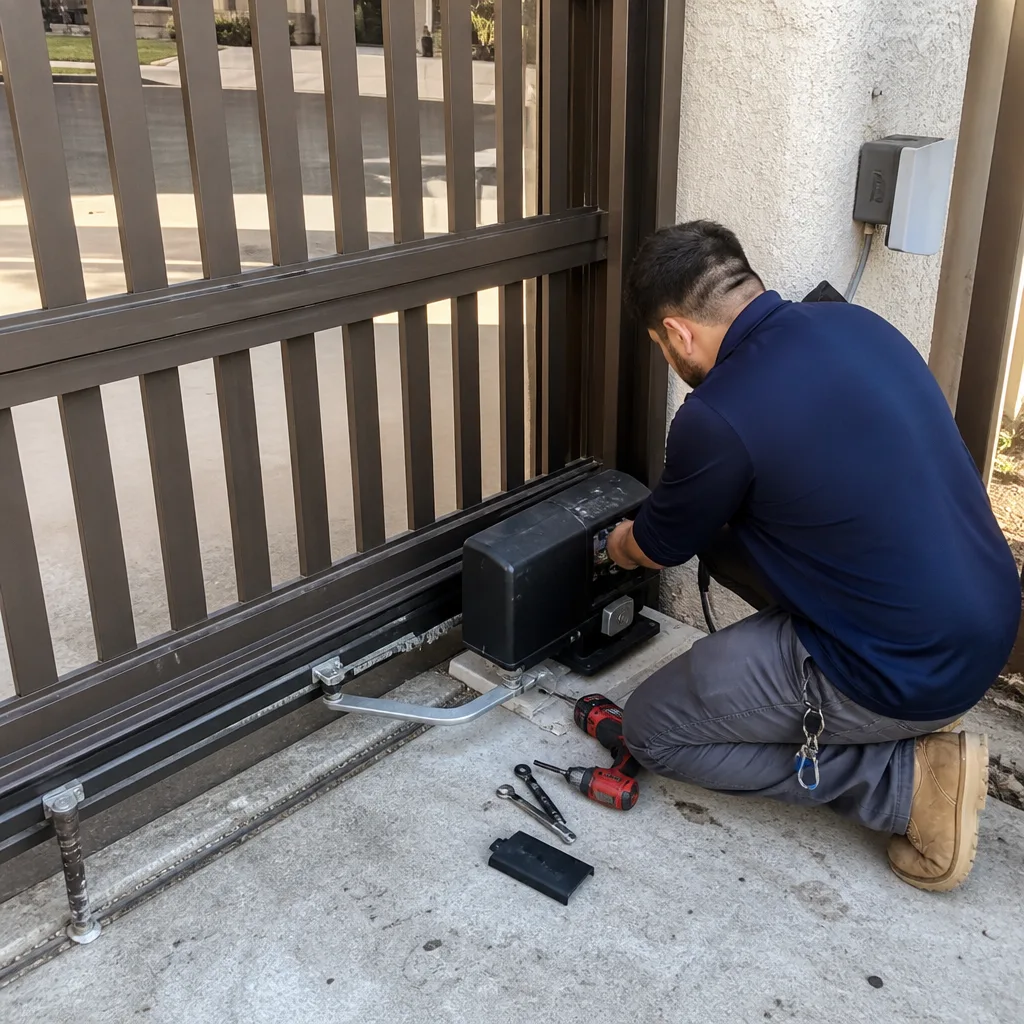 After
Frequently Asked Questions
Lubricate twice a year as a baseline: once in March before the marine layer settles in, and once in October before Santa Ana season. Add a third pass in winter only if you hear squeaking or feel resistance. Mission Viejo’s climate breaks down lubricants unevenly, so the manufacturer’s every-six-months schedule tends to miss both critical windows.
For solar-powered gates in Mission Viejo, this pattern usually means the panel is dirty or degraded and the battery is deficit-charging. The gate works in the morning on the previous day’s residual charge, then loses power through the afternoon as the solar panel fails to keep up. Clean the panel first and check the battery voltage before assuming a motor problem.
Yes, and the damage is usually delayed. A 60 mph gust transfers lateral force through the gate into the rollers, track, and stops. The damage shows up as grinding noise, a sticking gate, or misaligned limit switches days or weeks later, not during the wind event itself. Pre-wind inspections prevent most of this.
In most cases, that’s a capacitor that has failed in the motor start circuit, or the gate has jammed against an obstruction. If the humming continues for more than a few seconds, power the operator down and call a professional. Running a hummed-out motor burns through the windings quickly.
Often, yes. Older LiftMaster and Mighty Mule operators lack modern safety features and draw more power than newer models. If you’re already facing repeated service calls, replacement usually costs less than the accumulated repairs. Gate installation in Mission Viejo includes operator mounting, safety loop installation, and full calibration.
We service LiftMaster, FAAC, BFT, Linear, Viking, Ghost Controls, DoorKing, Elite, and Mighty Mule systems. Our technicians carry brand-specific replacement parts for these systems, so repairs don’t require a second trip for parts. We specialize exclusively in gates, which means our entire parts inventory and field experience is gate-specific. If you’re evaluating providers, read Choosing the Right Gate Repair Brand: A Buyer’s Guide for Mission Viejo.
The Bottom Line
Mission Viejo gates don’t fail randomly. They fail in seasonal patterns that track the local climate: marine layer moisture in spring oxidizes contacts, summer UV kills seals and starves solar batteries, Santa Ana winds shift alignment and overload rollers, and winter condensation bridges control board terminals. Each season has a specific set of checks that prevents the next season’s failures. Twice-a-year lubrication, spring and fall, covers the mechanical basics. The rest is about knowing which component your local climate is attacking this quarter. If a gate is already showing season-specific symptoms and you’d rather have a specialist look at it than guess, Gate Repair Mission Viejo offers free estimates in Mission Viejo. Call (866) 562-1205 and we’ll tell you exactly what’s wrong and what it costs to fix, before any work begins.
Written by the team at Gate Repair Mission Viejo, serving Mission Viejo since 2011.