
Emergency Gate Repair Near Me: What Mission Viejo Homeowners Should Do First
When your automatic gate stops responding in Mission Viejo, the first 20 minutes matter more than most people realize. The right steps can keep a $300 repair from becoming a $1,500 replacement. The wrong ones, like forcing a manual release or bypassing a safety sensor, do exactly the opposite. Here’s the sequence we recommend after a decade of watching gates fail in every possible way.
Stop. Walk Around the Gate Before Touching Anything
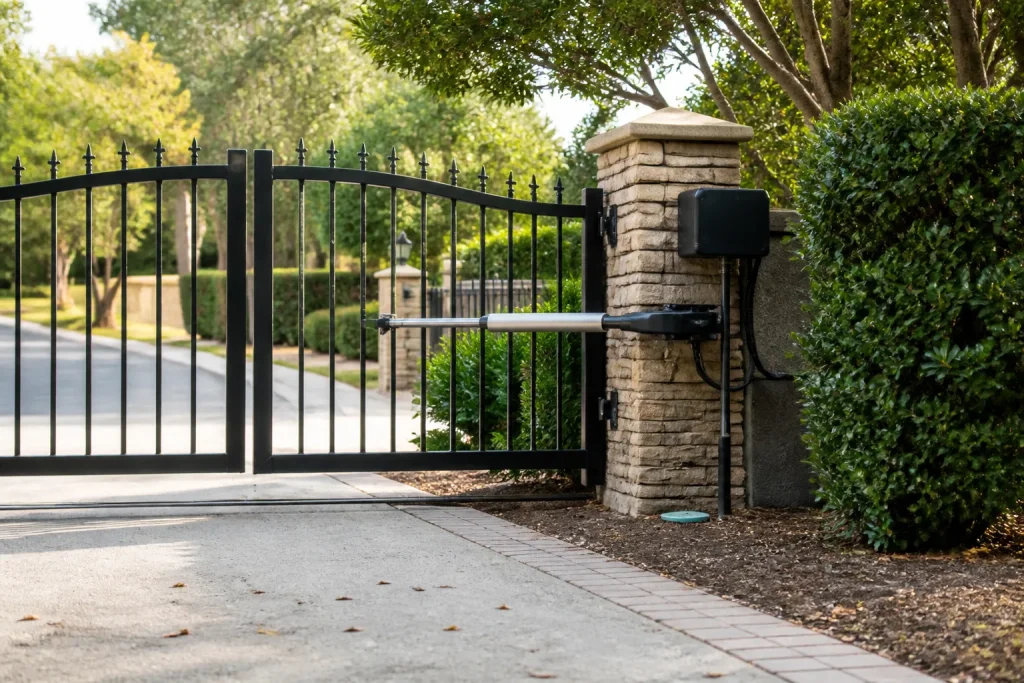
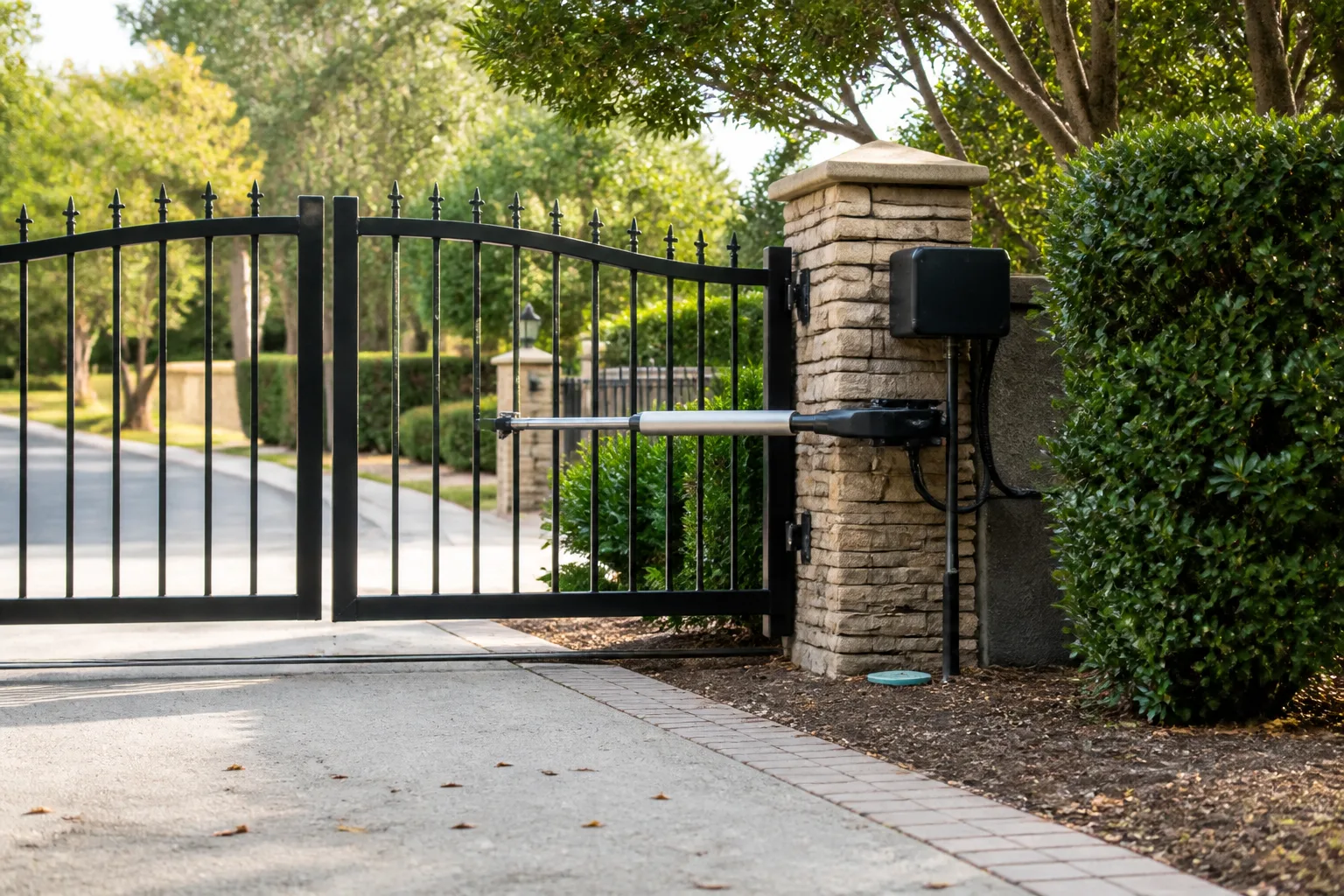
Most emergency damage happens in the first five minutes, not the first five hours. A homeowner sees the gate stuck, panics, and starts pulling on the operator’s manual release arm. On a LiftMaster operator, pulling the release while the motor is engaged can shear the limit-switch assembly. On a Viking system, forcing the arm the wrong direction strips the internal gears. On an Apollo (a brand we still see frequently around Lake Mission Viejo homes), reversing the release lever bends the worm-gear mount, which means a 3-to-5-day parts wait instead of a same-day fix.
Before you touch the release:
- Look for the error light. Most operators have a small LED on the control board or the front panel. Count the blinks. If it’s blinking in a pattern, write it down. A LiftMaster that blinks 4 times is a sensor problem. A FAAC that blinks 2 times is a motor thermal overload. That single pattern tells the tech what to load in the truck.
- Check the physical gate itself. Is it off its track, leaning, or hung up on something? A gate that’s physically jammed needs a different response than an electrical failure. Don’t try to muscle it back into place, you’ll bend the post brackets.
- Look at what’s under the gate. Landscape rocks, a sprinkler head, or a root that’s shifted can wedge a gate in the closed or half-open position. We’ve seen lawn crews in Mission Viejo accidentally set a gate on top of a rubber wheel chock more than once.
Only after you’ve checked the error light and the physical condition should you touch the manual release. And even then, brand matters. We wrote a separate Electric Gate Repair in Mission Viejo guide that covers this in depth. The short version: LiftMaster operators have a red release handle that you pull straight down. FAAC units use a keyed release mechanism, often on the side of the housing. Viking releases are typically a pull-chain or a lever behind a small door on the operator. If you don’t see the release mechanism immediately, don’t go digging for it. Call someone who knows the brand.
Decide: Should the Gate Stay Open or Stay Closed?
This is the question almost no homeowner asks in the moment, and it’s the one that determines whether you have a security emergency or a safety emergency. The answer changes what you do next.
If your gate is stuck open, and it protects a pool, a driveway where kids play, or back-alley access to your yard, you have a safety plus security problem. You need to either secure the opening or get the gate closed manually. If the gate is stuck closed and no one is trapped inside the property, you have an inconvenience, not a break-in risk. A closed gate is already doing its job. The temptation to force it open at 11 PM because you want to get the car in is exactly how gears get stripped.
For a gate stuck open in Mission Viejo:
- Search the operator housing for a manual release. Pull it according to the brand’s direction (downward for LiftMaster, quarter-turn keyed for FAAC, etc.), then push the gate closed by hand. Do it slowly. A gate that fights back is telling you something is bent or blocked.
- Once closed, use the gate’s built-in lock points. Most residential gates with a manual release port have a latch or slide-bolt. Engage it. If the operator has a mag-lock, don’t assume it will engage without power. It won’t.
- If the gate won’t close manually, mark the opening. Cones, a garbage bin, a string of reflective tape across the entry, whatever makes it obvious. Then call a neighbor, especially if the gate protects a pool. Mission Viejo is dense enough that a gate left open overnight will get noticed by someone. Better that someone is you and your neighbor than a stranger.
And what doesn’t work: zip ties around the operator arm, a cinder block jammed under the gate leaf, or a ratchet strap wrapped around the post. We’ve arrived at homes where all three were present. Zip ties snap. Cinder blocks shift. The gate either swings open in the wind or gets bent by a car that doesn’t see it.
What to Tell the Technician When You Call
Emergency calls go faster when the person on the other end of the line knows two things: the brand and the symptom. You don’t need to be a technician to provide either. You just need to look at the operator housing and describe what happened.
Here’s what saves a trip to the parts warehouse:
- The operator brand and model. It’s printed on the housing. LiftMaster, FAAC, Viking, Linear, DoorKing, Ghost Controls, or any other name you see. Read it out loud, even if you’ve never heard of it. We carry parts for nine specific brands, and knowing which one is in front of you means we arrive with the right capacitors, limit switches, or control board on the truck rather than guessing.
- What the gate was doing before it failed. Opened fine yesterday, stuttered this morning, now dead? That’s a capacitor or motor problem. Opened but wouldn’t close? That’s a safety-sensor or loop-detector issue. Nothing at all, not even a click? That’s power or a blown fuse. The sequence tells us more than the symptom.
- The error light pattern. As above, count the blinks. If the board is dark and you’ve confirmed the breaker isn’t tripped, say so.
- Whether anyone moved the gate manually. It’s embarrassing to admit you pulled on the release arm the wrong way. Tell us anyway. We’ve made worse mistakes. Knowing it saves us from misdiagnosing a stripped gear as a dead motor.
All of this applies to commercial and residential gates in Mission Viejo, from small Mighty Mule setups on side yards to Viking or DoorKing operators on HOA entries. The brand knowledge cuts diagnosis time in half. Our technicians know these systems specifically, the common failure points for each, and the parts that fail most. Not every gate company can say that. Many show up, look at the operator, and start searching for a manual online. We specialize exclusively in gates. It’s the only trade we work in.
How to Vet a 24-Hour Gate Repair Company at 10 PM
The emergency gate repair space attracts generalist handymen who answer the phone at any hour and figure out the problem after they arrive. You can sort the specialists from the guessers in the first 90 seconds of a phone call.
Ask these three questions:
- “What brands do you carry parts for?” A specialist can answer instantly: LiftMaster, FAAC, BFT, Linear, Viking, Ghost Controls, DoorKing, Elite, Mighty Mule. A generalist will say “all of them” or “whatever you got.” “All of them” means none of them, because nobody stocks parts for every manufacturer. A real gate company knows which brands they’re factory-familiar with and which ones require a parts order.
- “Can you talk me through the manual release on my specific operator?” If the person on the phone can’t walk you through a LiftMaster release sequence from memory, they don’t know the machine. If they tell you to “just pull the lever” without asking the brand first, hang up.
- “Will the tech quote the repair before starting?” The answer should be yes, always. A technician who can diagnose the problem on-site should be willing to give you a number before turning a wrench. The price gets quoted and agreed before any work starts. Anyone who says “we’ll see when we get in there” is preparing you for an invoice that reflects their uncertainty, not the actual repair.
One more signal: a legitimate gate specialist will ask you questions. They’ll want the error-light pattern, the gate type, the last normal behavior. If the person on the phone says “we’ll just send someone out,” they’re sending someone to diagnose from scratch. That’s fine for a scheduled call. For an emergency, it means you’re paying for their learning curve.
What We See Most in Mission Viejo (And What It Costs)
In our experience, the most common emergency failures across Mission Viejo break down like this:
- Capacitor failures on lift-master and Linear operators that are 6 to 10 years old. The gate hums but doesn’t move, or moves slowly and then stops. $80 to $180 in parts, often fixable same-day.
- Control board failures from power surges. Southern California Edison interruptions are a known adversary. $200 to $450 depending on brand.
- Broken hinges or weld failures on heavier residential gates. Especially near the lake, where moisture accelerates rust on older steel hardware. $150 to $400, sometimes requiring welding.
- Photo-eye or safety-sensor misalignment from a bump or landscaping work. The gate won’t close because it thinks something’s in the way. Often fixed in 30 minutes for a service call minimum.
- Stripped manual-release gears from someone pulling the release in the wrong direction, usually in a panic. $300 to $600, and the one that gets worse the longer it’s ignored.
We pulled a stripped release arm out of a side yard near Oso Creek last month. The homeowner had yanked the release on a Viking operator while the motor was mid-cycle. The motor was fine. The internal drive gear was ribbons. That’s the difference between a $175 service call and a $475 parts-and-labor job. If you’re in Mission Viejo and you’re looking at a gate that half-works, don’t wait until it fully dies. We cover this in more depth in our Gate Repair in Mission Viejo page, but the principle stands: the weird noise today is the emergency next week.
When to Call a Pro (And When to Wait Until Morning)
Not every gate failure is an emergency, and we’ll tell you that plainly. If the gate is stuck closed, no one is injured or trapped, and you don’t need your car out before morning, it can wait. Write down the error light pattern, shut off the breaker to the operator if you’re worried about power surges, and call for a scheduled repair the next day. You’ll get the same quality of work.
If the gate is stuck open and it protects a pool, a child, a pet, or anything you can’t replace, that’s the time to call at 10 PM. Same if the gate is making a grinding noise and continuing to operate, you’re doing active damage every cycle it runs. Power it down at the breaker and call. We offer free estimates over the phone, and the phone is answered by someone who can actually help you talk through the release procedure while you wait.
Related services in Mission Viejo: if the repair turns out to be more than the gate is worth, or the operator is discontinued, we handle Gate Installation in Mission Viejo as well. Same team, same brands. For the broader question of what gate repair covers in this area, start at our Gate Repair Mission Viejo home page.
The Bottom Line
When a gate fails in Mission Viejo, the sequence is simple: stop, read the error light, decide whether the gate needs to stay open or closed, then call someone who knows your brand before you touch anything. The right call prevents a small repair from becoming a parts wait. The wrong grab turns a capacitor into a gear replacement. If your gate is stuck, making noise, or dead, call a gate specialist who can tell you the manual-release procedure over the phone before the truck even rolls. If you’re in Mission Viejo and need help, we offer free estimates and brand-specific diagnosis. Call (866) 562-1205 and tell us the error light pattern. We can probably tell you what’s wrong before we arrive.
Frequently Asked Questions
Same-day availability is typical for gate failures reported during business hours, and we answer 24/7. The key variable is the brand of your operator and the part needed. A stocked capacitor or limit switch for a common brand like LiftMaster or FAAC can be on-site and fixed the same evening. A discontinued control board for an older Viking or an Apollo with stripped internals may require a parts order, and no company can change a manufacturer’s shipping time. Call with the brand and error-light pattern to get an accurate estimate of the visit window.
The most common causes in Mission Viejo are capacitor failures (the gate hums but won’t move), blown fuses or tripped breakers, photoelectric safety-sensor misalignment, and control board damage from a power surge. Physical issues like a shifted hinge or a root under the gate can also stop movement. The error light pattern on the operator typically tells us which category you’re in before we touch anything.
Most emergency gate repairs in Mission Viejo run between $175 and $600. The lower end covers a service call plus a capacitor or sensor realignment. The upper end covers a control board replacement or a stripped-drive repair on brands like Viking or DoorKing. The price is always quoted and agreed before any work starts, and no emergency visit should begin without a number in front of you. Call (866) 562-1205 for a phone estimate based on your specific operator brand and symptom.
Yes, but only by using the manual release mechanism designed for that specific operator, and only in the direction that the manufacturer intends. LiftMaster, FAAC, Viking, and Linear all use different release systems. Pulling the wrong way can strip internal gears or shear a limit switch, converting a power-outage headache into a parts-order problem. If you cannot identify the release or understand its operation, call a technician who can talk you through it over the phone.
Written by the team at Gate Repair Mission Viejo, serving Mission Viejo since 2011.
Need Gate Repair Help?
Call Gate Repair Mission Viejo - licensed & insured, here with fast help in Mission Viejo.
(866) 562-1205